Not a platform migration. Not ad spend. A formal three-phase SEO strategy with a per-SKU competitive keyword rewrite as its highest-leverage execution.
The strategy was structured around three sequential objectives. Visibility first: rank for the queries buyers actually use. Engagement second: ensure the SERP result sets accurate expectations so visitors do not bounce. Conversion third: remove on-page friction between landing and purchase. The metadata rewrite operated in Phase 1 and Phase 2 simultaneously — adding competitive keyword depth and embedding value propositions like free shipping directly in SERP copy before the click.
Competitive keyword gap analysis per product, entity keyword footprint depth, longtail natural-language query targeting
SERP copy value propositions, intent-matched keywords to reduce bounce, mobile optimization
ATF CTA placement, structured FAQ blocks, pain-point copy, shipping and returns structured markup
The differentiator: Most Shopping feed rewrites apply the same title formula across all SKUs. This program treated each product individually, because keyword opportunities differ meaningfully by product type and competitive set. Uniform templates produce uniform mediocrity. Per-SKU research produces results that compound.
SEMRush gap analysis against top-ranking Shopping competitors in each category. Every opportunity logged in a tracking spreadsheet with a dedicated "Keyword Opps" column and competitive rationale for each change.
Beyond primary search terms, product copy was expanded with entity keywords — related terms that strengthen whole-page relevance. Niche products with narrower keyword sets received different treatment than high-volume categories; footprint depth varied by opportunity.
Every title rewritten within the 47–60 character range: primary keyword, product type, and one differentiating attribute (spec, rating, or material) without truncation in Shopping display.
Every description rewritten to 150–160 characters: benefit-forward structure, primary use case first, key specifications second. Products over $99 received "free shipping" as a deliberate SERP-level conversion signal.
The before/after below shows the structural difference in a single product. Same item, same price. The keyword signal density, benefit framing, and character utilization change completely. The Shopping algorithm reads both versions differently because they are different.
The GA4 data compares the organic Google Shopping channel for Jan 1–Dec 16, 2024 against the same period in 2025. The rewrite began in September 2024, making 2025 the first full year of optimized feed data against a pre-rewrite baseline.
GA4 Organic Shopping Channel — Active Users: 1,152 (2024) vs. 16,460 (2025) — Growth: +1,328.82%
On data sources: The keyword tracking spreadsheet documents organic search ranking positions. The GA4 result documents organic Shopping channel performance. These are separate systems. The 1,328% figure is drawn from the Shopping segment in GA4 specifically, not inferred from keyword rankings. That distinction is stated clearly because it matters.
The parallel organic channel ran simultaneously and showed its own gains: 78,889 organic visits, up 16.2%, with average position improving from 15.6 to 8.2. Documented separately because they are separate things.
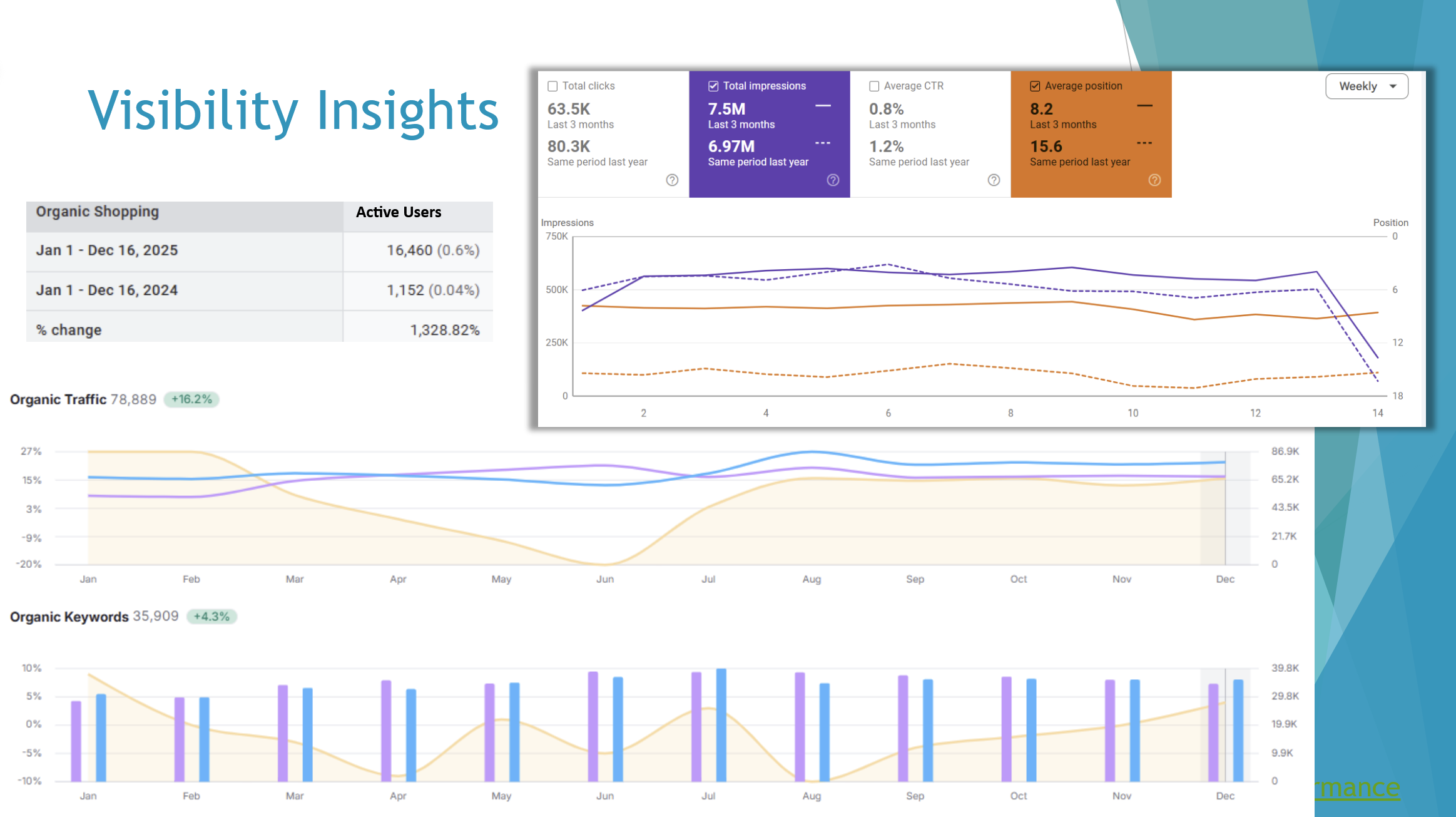
Parallel Organic Channel — 78,889 Visits (+16.2%) · Avg. Position 15.6 → 8.2
The Shopping rewrite, the content program, and the AEO strategy all ran in parallel across the same engagement. Each is documented separately, with its own data source, because they are separate systems with separate mechanisms. That is how you tell whether the work is real.
Most eCommerce feeds run on default copy. A per-SKU audit shows exactly what the gap is worth before any work begins.
Book an eCommerce SEO Audit